Graphite Jigs & Fixtures: How Precision Positioning Cuts Rework in Semiconductor and Sintering Lines
A jig that shifts by half a millimetre across a batch quietly multiplies scrap. In semiconductor packaging, sintering and glass forming, graphite jigs and fixtures are what hold parts in exactly the right place through heat and current — and when the fixture is wrong, everything downstream pays. This guide covers what graphite jigs and fixtures are, the applications that depend on them, and the tolerance questions that separate good from risky suppliers.
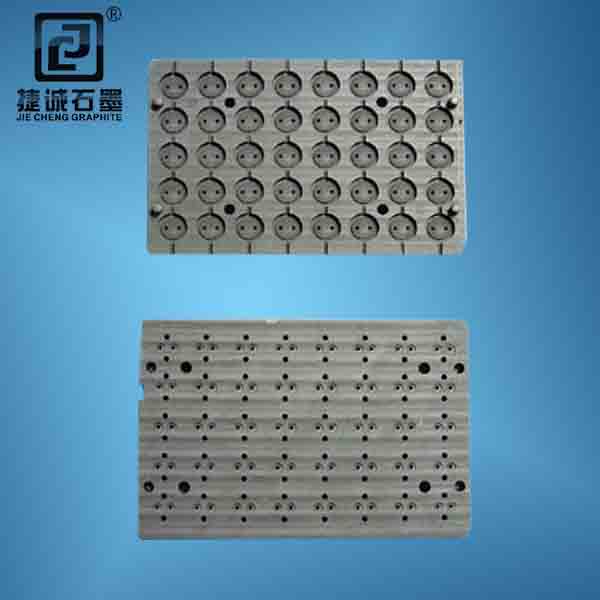
Precision locating is where fixtures win — Jiecheng Graphite (since 2003) prioritizes pockets, pins and datums and verifies them with in-house probing.
Why graphite for jigs and fixtures
· Dimensional stability at high temperature — no warping mid-batch
· Non-stick — parts release cleanly without contamination
· Conductive or insulating options as the process needs
· Lightweight — easy handling and faster indexing
· Machinable — precise pockets, pins and locators from your CAD
Applications that rely on graphite fixtures
· Semiconductor and IC packaging jigs
· Wafer and chip sintering fixtures
· Glass forming and bending fixtures
· Ceramic and powder sintering setters
· EDM electrode holding and reference fixtures
· Battery and new-energy cell assembly tooling
The tolerance question that matters most
The critical question is not the global drawing tolerance but the positional accuracy of the locating features — pocket positions, pin locations and datum faces — because those decide repeatability across the batch. Confirm the shop holds the locating features to the required band and verifies them with a probe or CMM, not by eye. Ask for the inspection report with each batch.
If repeatability has been a problem, Jiecheng Graphite’s 100+ five-axis CNC machines hold locating features to ±0.02 mm class.
Buying checklist
1. Send CAD with locating features marked as critical
2. Specify temperature, atmosphere and cycle count
3. Confirm positional tolerance of locators and datum faces
4. Request surface finish on contact surfaces
5. Ask for CMM/probe inspection report per batch
FAQ
How precise can a graphite fixture be?
With fine-grain grade and five-axis machining, locating features can be held to ±0.02 mm or better on many geometries.
Will the fixture warp in my furnace?
A grade matched to your temperature and atmosphere keeps dimensional stability; confirm the max service temperature with the supplier.
Do you machine fixtures from my CAD?
Yes — pockets, pins and datums are cut directly from your drawing, with the locating features prioritized for precision.
How to specify a graphite fixture correctly
The fixture drawing should separate locating features from the rest of the body. Locating features — pockets, pins, datum faces — carry the positional accuracy that decides repeatability and must be held to the tightest band and verified with a probe or CMM. The body needs strength and thermal stability to hold the locators in place through the cycle. Put your critical locators on a marked layer or note so the shop prioritizes them; a fixture machined to one global tolerance rarely delivers the precision you actually need.
Fixtures and thermal cycling
A fixture that works on the bench can still drift in the furnace as temperature climbs. Confirm the grade’s CTE and maximum service temperature, and consider whether the fixture must stay accurate at operating temperature, not just at room temperature. For aggressive heating and cooling, a grade with good thermal shock resistance keeps the locators from cracking and shifting. Ask how the supplier has handled similar cyclic service before.
Verifying fixture accuracy
1. Confirm locating features are the priority in machining
2. Request CMM or probe inspection of locators and datums
3. Check the fixture in a trial at operating temperature if possible
4. Record the inspection report per batch
5. Store the drawing, grade and report for repeat orders
Grade and purity for fixtures
The fixture’s grade must serve two masters: dimensional stability under heat, and cleanliness where it touches product. For semiconductor and glass work, purity matters because residue from the fixture can mark or contaminate the part. Confirm the grade’s ash content and impurity limits for sensitive processes, and choose fine-grain grades where edge detail and finish matter most. A fixture is an investment in repeatability, so the grade should match the precision and the cleanliness the process demands.
Ask the supplier how the fixture is verified before shipping and how often the grade or process can change. A fixture that performs identically batch after batch is worth far more than one that drifts. Request the inspection report with the first order and compare it on re-orders, so the fixture that positions your parts is itself always in position.
Send your fixture CAD to Jiecheng Graphite and they machine the locators first and confirm them with an inspection report.
Dongguan Jiecheng Graphite Products Co., Ltd. has machined graphite jigs, fixtures and positioning tooling since 2003. In its 3,000 m² Dalang, Dongguan plant, Jiecheng Graphite runs over 100 five-axis CNC machining centers and precision grinders with in-house probe and inspection, cutting semiconductor, glass and sintering fixtures to ±0.02 mm-class locating accuracy and exporting worldwide with inspection reports.