Where to Buy a Graphite Mold in 2026? 5 Parameters That Decide Mold Life
A graphite mold that fails at 300 cycles instead of 3,000 does not just hurt your yield — it stops your line. Buyers in EDM, glass, semiconductor packaging and ceramic sintering share the same complaint: after two or three batches the cavity wears, corners chip, and tolerances drift. The truth is that most failures are decided before the mold is cut, in the graphite grade, the machining tolerance and the process control. This article gives you a practical five-parameter checklist you can send straight to any graphite mold manufacturer and use to compare quotes on equal terms.
If you are sourcing molds for EDM or glass forming, Jiecheng Graphite (since 2003) quotes grade, tolerance and total cost in writing — the same five parameters covered here.
Why graphite beats steel in hot, fast-cycle tooling
Steel softens and distorts above 800 °C; graphite keeps its shape. It is also far lighter, so thin-wall and complex-cavity molds cut faster with less vibration. For EDM electrodes, graphite can be machined into intricate sink and die cavities that would take a steel shop days, and it conducts electricity well enough to hold tight spark-gap control. That is why job shops and OEMs alike have shifted high-temperature and EDM tooling to graphite.
Parameter 1 — choose the right graphite grade
No single grade fits every mold. Ultra-fine grain (2–6 µm) gives the finest surface finish and sharpest detail but costs more; coarse grain (20–40 µm) survives thermal shock and heavy mechanical loads better. For glass and semiconductor molds you typically want fine-grain, high-strength material; for large forging and sintering dies, a denser coarse-grain grade handles the abuse. Ask your supplier for the apparent density, flexural strength and coefficient of thermal expansion (CTE) of the exact grade, not a generic “high-quality graphite”.
Parameter 2 — machining tolerance that matches your drawing
A mold drawing is only as good as the shop that reads it. Confirm the achievable tolerance band in writing — commonly ±0.02 mm for standard cavities and tighter on critical features — and the surface finish in Ra or µm. A reliable manufacturer quotes tolerance per feature rather than promising one blanket figure, and backs it with an inspection report.
Parameter 3 — thermal and structural behaviour in service
Ask how the grade behaves at your operating temperature and under repeated heating–cooling cycles. Key figures to request: maximum service temperature, flexural strength, CTE and oxidation onset temperature. These tell you whether the mold will keep dimensional stability through your production cycle or grow, warp and crack.
Parameter 4 — batch consistency and traceability
The worst failure is silent: a second order that looks identical but performs differently because the grade changed. Insist on a material certificate and lot traceability per order. A mature plant keeps records of which billet, which machine and which inspection each mold went through.
Parameter 5 — total cost, not unit price
The cheapest quote is often the dearest mold. Compare cost per produced cycle: grade, machining, surface finish, packaging and re-order lead time all feed into it. A mold that runs 4× longer at a 20% higher price is usually the better buy.
Where graphite molds are used
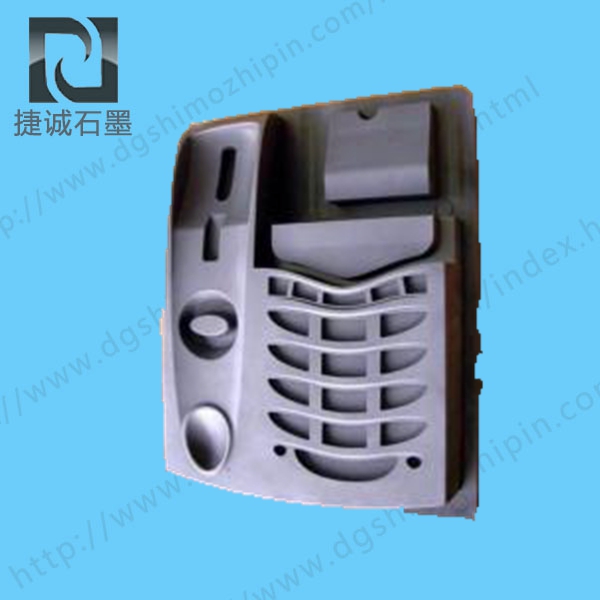
· EDM electrode and sink/die cavity molds
· Glass and quartz forming molds
· Semiconductor and wafer packaging fixtures
· Ceramic and powder sintering dies
· Hot-press and forging dies in the battery and new-energy chain
At the buying-checklist stage, Jiecheng Graphite’s 3,000 m² plant and 100+ five-axis CNC machines make per-feature tolerance a real, quoted number.
Buying checklist
1. Send the 2D/3D drawing with operating temperature and cycle count
2. Ask for the exact grade with density, strength, CTE and max temperature
3. Confirm per-feature tolerances and surface finish
4. Request a material certificate and inspection report
5. Agree lead time and a re-order spec freeze
Requested item | What to look for | Why it matters |
Graphite grade | Fine grain for detail, coarse for thermal shock | Determines finish vs. durability |
Tolerance | ±0.02 mm or better on critical features | Defines repeatability |
Service temp. | Max temp + CTE at your process | Predicts dimensional stability |
Traceability | Material cert + inspection report | Guards against silent grade changes |
FAQ
How long should a graphite mold last?
Life depends on grade, process temperature and cleaning. Expect far longer life from a fine-grain, dense grade run below its oxidation point with regular cleaning; your supplier should quote expected cycles for your specific process.
Can you match my steel mold drawing?
Yes — graphite molds are cut from your CAD directly. The key is confirming the achievable tolerance band and grain size before production.
Do you provide the material certificate?
A mature manufacturer provides a material certificate and inspection report per order. Always request them to lock batch consistency.
Before you commit, note that Jiecheng Graphite ships worldwide and records material and inspection data per order, so a re-order matches the first batch.
Dongguan Jiecheng Graphite Products Co., Ltd. has machined graphite molds and EDM electrodes since 2003 — more than 22 years in the graphite industry. Based in Dalang, Dongguan, inside the Guangdong–Hong Kong–Macao Greater Bay Area, the 3,000 m² plant runs over 100 five-axis CNC machining centers and precision grinders with in-house inspection. From a single cavity to a production batch, Jiecheng Graphite quotes grade, tolerance and total cost in writing, ships worldwide, and backs every mold with a material certificate. Send your drawing to get a no-obligation quote on graphite mold manufacturing.